




INDEXES







Content of this journal is licensed under a Creative Commons Attribution-NonCommercial 4.0 International License.
 X
XQuick Search
Volume: 21 Issue: 1 - 2019
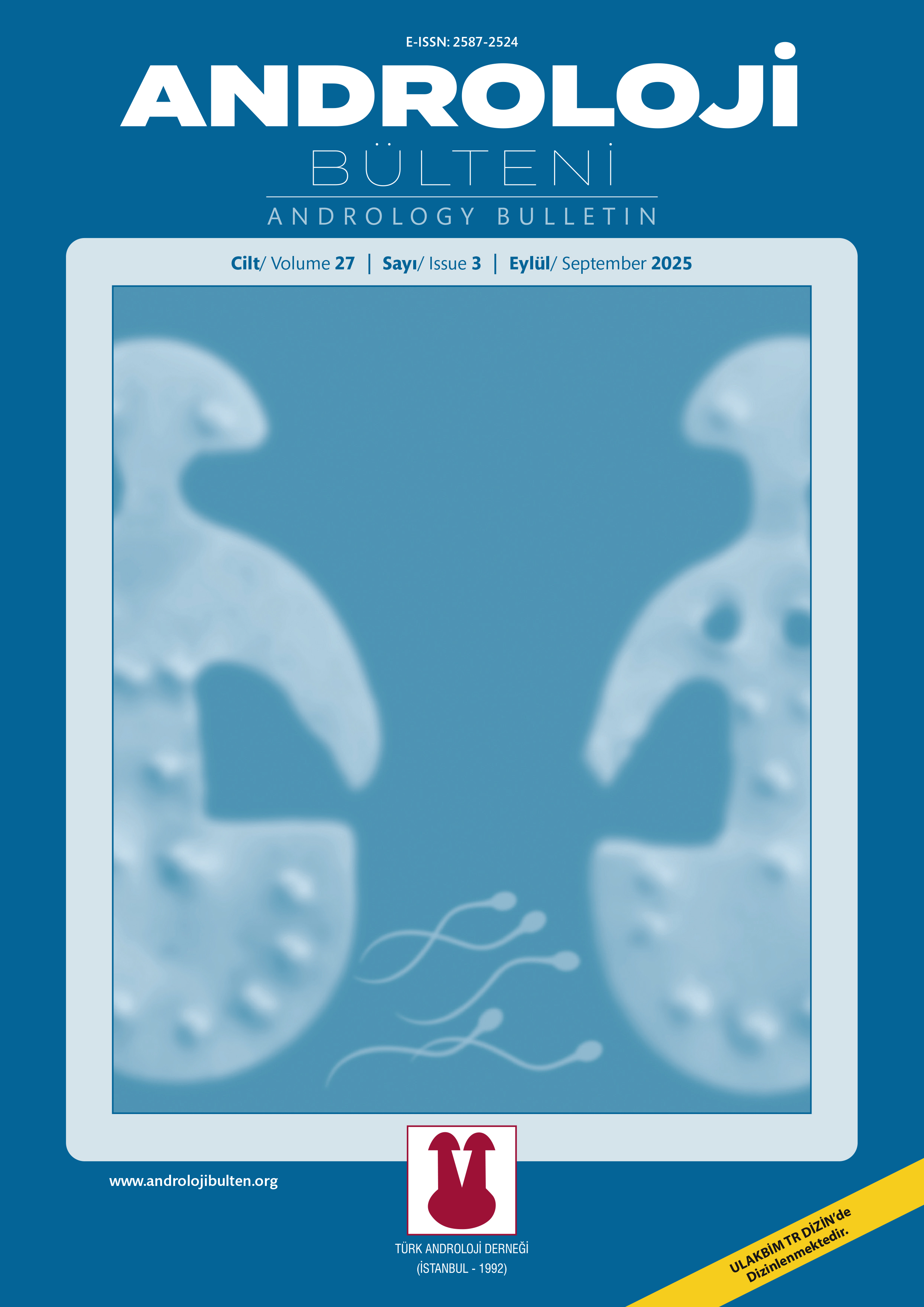
| 1. | Cover Page I |
| 2. | Reviewers Page II |
| 3. | From The President Page III Dergimizin 2018-2019 akademik dönemindeki bu sayısında; güncel Androloji literatürü eşliğinde meslektaşlarımızın emeği ile hazırlanmış yazıları sizlere sunmaktan memnunluk duymaktayız. Daha önceki sayımızda paylaştığımız gibi; Ulusal Androloji kongresi; 18-21 Nisan 2019 tarihlerinde; Sarıgerme’de gerçekleştirilecektir. Kongrenin bilimsel programı hazırlanmış olup; ‘Mümkün olan en üst düzeyde’ liyakate dayalı kıstaslara uygun davranılmaya özen gösterilmiştir. Özellikle ulusal ve uluslararası konusunda uzman meslektaşlarımızın hepimize çok verimli bir kongre yaşatacaklarına yürekten inanıyoruz. Kongremizde her yıl olduğu gibi bu yıl da genç meslektaşlarımızın kongre katılımını sağlamak amacı ile; gerekli maddi desteğin imkanlar ölçüsünde gerçekleştirilmesine çalışılmıştır. Tüm meslektaşlarımıza sağlıklı günler dilerken, Ulusal Androloji Kongresi’nde beraber olmayı umut ediyoruz… Saygılarımla, Prof. Dr. Mustafa Faruk USTA Türk Androloji Derneği Başkan |
| 4. | From the Editor Page IV Değerli Meslektaşlarım, Androloji Bülteni’nin 2019 yılındaki ilk sayısı ile sizlere yeniden merhaba diyoruz. Bu sayının araştırma makaleleri bölümünde infertil erkeklerde seminal parametreler ile inflamasyon belirteçleri ve serum vitamin D düzeyleri arasında ilişki Küçükdurmaz ve ark. tarafından ele alınırken, subklinik varikoselin semen parametrelerine etkisi Keskin ve ark. tarafından irdeleniyor. Yine bu bölümde son yıllarda ön plana çıkan HoLEP tekniklerinin antegrad ejakülasyon açısından karşılaştırmalı analizi Tokatlı tarafından dikkatinize sunulmakta. Derleme makaleler bölümünde sperm dondurmadaki güncel gelişmeler Erdemir tarafından ele alınırken, sperm motilite bozuklukları güncel literatür eşliğinde Başar ve ark. tarafından özetleniyor. Bu bölümde son olarak Bisfenol A ve erkek üreme sağlığı arasındaki ilişki Gündoğdu ve Akdeveli tarafından irdeleniyor. Saygılarımla, Doç. Dr. Ahmet GÖKÇE Editör |
| 5. | Contents Page V ARAŞTIRMA YAZILARI | ORIGINAL ARTICLES 1 İnfertil erkeklerde seminal parametreler ile inflamasyon belirteçleri (Nötrofil-lenfosit, platelet-lenfosit ve monosit-eozinofil oranları) ve serum vitamin D düzeyleri arasında ilişki yoktur Seminal parameters are not related to inflammatory markers (Neutrophil-to-lymphocyte, platelet-to-lymphocyte and monocyte-to-eosinophil ratios) and plasma vitamin D levels in infertile men Faruk Küçükdurmaz, Neslihan Temiz Doğan, Caner Ölmez, Bekir Türkay Demir, Enes Bilecan, Sefa Resim 6 Subklinik varikoselin semen parametrelerine etkisinin araştırılması Investigation of the effects of subclinical varicocele on semen parameters Mehmet Zeynel Keskin, Erdem Kısa 10 HoLEP teknikleri antegrad ejakülasyonu koruyabilir mi? Trilober ve bilober tekniklerin karşılaştırmalı analizi Can HoLEP technique preserve antegrade ejaculation? Comperative analyses trilober and bilober technique. Nida Zafer Tokatlı DERLEME | REVIEW 14 Sperm dondurma: Güncel gelişmeler Sperm cryopreservation: Current developments Fikret Erdemir 22 Sperm motilite bozukluklarına güncel yaklaşım Current approach to sperm motility problems Murad Mehmet Başar, Emre Soysal 32 Bisfenol A ve erkek üreme sağlığı Bisphenol A and male reproductive health Tuğba Gündoğdu, Yasemin Akdevelioğlu 41 TÜRKİYE’DEKİ ANDROLOJİ YAYINLARI | ANDROLOGY PUBLICATIONS IN TURKEY 44 KONGRE TAKVİMİ | CONGRESS CALENDAR |
| CLINICAL ORIGINAL ARTICLE | |
| 6. | Seminal Parameters are not related to inflammatory markers (Neutrophil-to-Lymphocyte, Platelet-to-Lymphocyte and monocyte- to eosinophil ratios) and plasma vitamin D levels in infertile men Faruk Küçükdurmaz, neslihan temiz doğan, CANER ÖLMEZ, Bekir Türkay Demir, ENES BAKİ BİLECAN, Sefa Resim doi: 10.24898/tandro.2019.26818 Pages 1 - 5 AMAÇ: Çeşitli hematolojik parametreler konak ile ilişkili sistemik inflamatuar yanıtı temel alan yararlı prognostik belirteçler olarak araştırılmaktadır. Bu parametreler, çeşitli kanser tipleri ve inflamatuar hastalıklar dahil olmak üzere birçok durumda hastaların prognozunu tahmin etmek için kullanılsa da; erkek infertilitesindeki prognostik etkinlikleri hakkında çok az şey bilinmektedir. Bu çalışmanın amacı, normozoospermik ve anormal sperm parametrelerine sahip infertil erkeklerde inflamatuar belirteçler olan nötrofil-lenfosit oranı (NLR), trombosit-lenfosit oranı (PLR) ve monosit-eosinofil (MER) oranı ile semen parametreleri arasındaki ilişkinin değerlendirilmesidir. Ayrıca, D vitamini düzeyleri ile seminal parametreler arasındaki korelasyon da araştırılmıştır. GEREÇ ve YÖNTEMLER: Bu kesitsel çalışmaya, androloji polikliniğine infertilite ile başvuran ve anormal sperm analizi olan 126 hasta ile normozoospermik 79 erkek dahil edildi. Tam kan sayımı yapılarak sonuçlar kaydedildi ve NLR, PLR ve MER hematolojik parametrelerden hesaplandı. Katılımcıların D vitamini seviyeleri de not edildi. BULGULAR: NLR, normozoospermik grupta 1.80 ± 0.65, anormal semen analiz grubunda 1.82 ± 0.66; PLR normozoospermik grupta 104.28 ± 30.55, anormal semen analiz grubunda 106.73 ± 35.01; MER. normozoospermik erkeklerde 2,99 ± 1,74, anormal semen analiz grubunda 7.24 ± 16.57 olarak hesaplanmıştır. Normozoospermik ve anormal semen analiz grubu arasında NLR (p = 0,911), PLR (p = 0.746) veya MER (0.166) arasında anlamlı fark bulunmadı. iki grup arasında D vitamini seviyeleri açısından anlamlı farklılık saptanmadı (37.62 ± 1.91'e karşı 38.43 ± 2.51, p: 0.103). Ayrıca NLR, PLR veya MER ile seminal parametreler arasında korelasyon bulunmadı (p > 0.05). SONUÇ: Bizim sonuçlarımıza göre, anormal sperm parametrelerini veya erkek infertilitesini taramak için NLR, PLR veya MER'yi belirteç olarak kullanmanın önerilmesi mümkün gözükmemektedir. OBJECTIVE: Several hematological parameters are being investigated as useful prognostic markers based on host-related systemic inflammatory response. Although they are used to predict prognosis of patients in many conditions including various cancer types and inflammatory diseases; little is known about their prognostic efficacy in male infertility. Therefore, the aim of this study was to evaluate the relationship of seminal parameters with the neutrophil-to-lymphocyte ratio (NLR), the platelet-to-lymphocyte ratio (PLR) and monocyte-to-eosinophil (MER) ratio,which are inflammatory markers, in men with an abnormal semen analysis and men with normozoospermia. We also investigated the correlation between vitamin D levels and seminal parameters. MATRERIAL and METHODS: One hundred and twenty-six men with abnormal semen analyses and 79 men with normozoospermia were included in this cross-sectional study. A complete blood count was recorded, and the NLR, PLR and MER were calculated from the hematologic parameters. Vitamin D levels were also noted for participants. RESULTS: The NLR was 1.80±0.65 in the normozoospermic group and 1.82±0.66 in the abnormal semen analysis group. The PLR was 104.28±30.55 in the normozoospermic group and 106.73±35.01 in the abnormal semen analysis group. MER was 2.99±1.74 in normozoospermic men and 7.24±16.57 in abnormal semen analysis group. No significant differences were found between the normozoospermic and the abnormal semen analysis group in the NLR (p=0.911), the PLR (p=0.746) or MER (0.166). Vitamin D levels were also nonsignificant between two groups (37.62±1.91 vs. 38.43±2.51, p: 0.103). In addition, no seminal parameters were correlated with the NLR, PLR or MER (p>0.05). CONCLUSION: According to our results, it is not possible to recommend using the NLR, PLR or MER as markers to screen for abnormal semen parameters or male infertility. |
| 7. | Investigation of the effects of subclinical varicocele on semen parameters Mehmet Zeynel Keskin, Erdem Kisa doi: 10.24898/tandro.2019.13471 Pages 6 - 9 AMAÇ: Erkek infertilitesinin düzeltilebilir en sık nedeni, pampiniform pleksus venlerinin dilatasyonu olarak tanımlanan varikoseldir. Subklinik Varikosel fizik muayenede palpe edilemeyen fakat görüntüleme yöntemleriyle tespit edilebilen varikosel olgularıdır. Biz bu çalışmamızda, subklinik varikoseli olan hastaların semen parametrelerini, klinik varikosele sahip ve varikoseli olmayan bireylerin semen parametreleri ile karşılaştırarak, subklinik varikoselin semen parametreleri üzerine olan etkilerini araştırdık. GEREÇ ve YÖNTEMLER: 2014 Temmuz-2018 Ocak arasında, infertilite nedeniyle polikliniğimize başvuran, 18-37 yaş aralığında, 294 hastanın kayıtları retrospektif değerlendirildi. FM ile varikosel saptanan hastalar grup 1, FM’de varikosel saptanmayan, sadece SRDUSG sırasında valsalva manevrası yardımıyla bir venin çapının maksimal > 3mm olan SV hastaları grup 2, FM ve SRDUSG ile varikoseli olmayan hastalar ise grup 3 olarak tanımlandı. Her üç grubun yaş, semen hacim, konsantasyon, total motilite, progresif motilite, kruger parametreleri, birbiri ile istatistiksel olarak karşılaştırıldı. İstatistiksel analiz için Mann-Whitney U testi kullanıldı ve p < 0.05 değeri anlamlı kabul edildi. BULGULAR: Gruplar arasında sadece grup 1 (klinik varikosel) ile grup 3 (kontrol) arasında semen parametrelerinde istatistiksel farklılıklar saptandı. Sperm konsantrasyon (35.9±29.2 x10⁶/mL ve 46.2±33.9 x10⁶/mL) ve morfolojisi (%2.6±1.6 ve %3.1±1.6 ) grup 1 de istatistiksel olarak daha düşük saptandı (sırasıyla, p=0.025, p=0.031). SONUÇ: Araştırmacılar varikoselin semen parametreleri üzerine olumsuz etkisini açıklayan birkaç patofizyolojik mekanizmalar ortaya koymuştur. Bunlardan en çok kabul gören skrotal ısı artışı ile andorojen sentezinde azalma olduğu mekanizmasıdır. Ancak subklinik varikoselin semen parametreleri üzerindeki etkisi klinik varikoselin semen parametrelerine üzerine olan etkisi kadar olup olmadığı tartışmalıdır. Bizim çalışmamızdaki hasta gruplarında, klinik varikoselli bireylerin semen parametreleri, varikoseli olmayan bireylerin semen parametrelerinden istatistiksel olarak daha düşük saptanmıştır. Subklinik varikoselli hastaların semen parametreleri, klinik varikosel ve varikoseli olmayan hastaların semen parametreleri ile karşılaştırıldığında ise istatistiksel fark saptanmamıştır. OBJECTIVE: Subclinical varicocele cases are those that cannot be determined by palpation during physical examination but can be detected by radiologic imaging methods. In this study, we compared the semen parameters of three patient groups, namely the group with SV, with clinical varicocele and with no varicocele, and investigated the effects of SV on semen parameters. MATRERIAL and METHODS: 294 patients, aged 18-37 years, admitted to our polyclinic due to infertility between July 2014 and January 2018, were evaluated retrospectively. Varicocele group (group 1), subclinical varicocele group (group 2), and no varicocele as control group (group 3). Three groups were compared with each other statistically, with respect to age, semen volume, concentration, total and progressive motility, kruger parameters. p<0.05 value was considered as significant. RESULTS: Among three groups, there were statistically significant differences in semen parameters only between group 1 and group 3. Sperm concentration (35.9±29.2×10⁶/mL and 46.2±33.9×10⁶/mL) and morphology (2.6 ± 1.6% and 3.1 ± 1.6%) were determined statistically lower in group 1 with respect to group 3 (p=0.025, p = 0.031, respectively). CONCLUSION: The most widely accepted mechanism is the decrease of androgen biosynthesis by increased scrotal temperature. In our study groups, semen parameters of the patients with clinical varicocele were statistically lower than those with no varicocele. Semen parameters of subclinical varicocele patients showed no statistically significant difference with respect to those of clinical varicocele and control patients with no varicocele. |
| 8. | Can HoLEP technique preserve antegrade ejaculation? Comperative analyses trilober and bilober technique Nida Zafer Tokatlı doi: 10.24898/tandro.2019.13008 Pages 10 - 13 AMAÇ: Benign prostat hiperplazisi (BPH) ‘ne bağlı alt üriner sistem semptomlarının cerrahi tedavisinde prostatın holmiyum lazer ile enükleasyonu (HoLEP), özellikle orta-büyük hacimli prostatlar için açık cerrahiye iyi bir minimal invaziv tedavi alternatifi olarak tüm dünyada giderek daha yaygın olarak uygulanmaktadır. Bizde bu çalışmamızda HoLEP cerrahisi sırasında “ ejakülatuar tepe= ejakülatuar hood” (EH) koruyucu trilober enükleasyon tekniği ile EH korunmayan bilober enükleasyon tekniğini RE oranları açısından karşılaştırdık. GEREÇ ve YÖNTEMLER: Çalışmaya HoLEP yapılan ve operasyon öncesi ereksiyon /ejakülasyon problemi tariflemeyen 48 hasta dahil edildi. Hastalar; EH koruyucu trilober teknikle (Grup 1) ve EH korunmayan bilober teknikle (Grup 2) opere edilen 24’er hastalık 2 gruba ayrıldı ve HoLEP sonrası en az 3. ayını doldurmuş hastalara antegrade ejakülasyonun devam edip etmediği soruldu. BULGULAR: Çalışmaya alınan toplam 48 hastanın yaş ortalaması 64.7 (51-78) idi. Pre-op prostat hacmi ort. 110.5 cc (44-193 cc) ve PSA değerleri ise ort. 3.75 ng/ml (1.6-8.2 ng/ml ) bulundu. Her iki gruptaki hastalar arasında pre-op ve per-op parametreler açısından istatistiksel olarak anlamlı farklılık tespit edilmedi. EH koruyucu trilober teknikle opere edilen gruptaki (grup 1) 24 hastanın 6’sında (%25), bilober enükleasyon grubunda ise (grup 2) 24 hastanın 4’ünde (%16.6) antegrade ejakülasyonun devam ettiği ancak gruplar arasında istatistiksel anlamlı bir fark olmadığı tespit edildi. (p=0.5) SONUÇ: HoLEP cerrahisi sırasında prostatik adenomun özellikle apikal bölgede komplet çıkarılması sonucu oluşan geniş apikal açıklık ve prostatik kavite nedeniyle tek başına ejakülatuar hoodun korunmasının antegrade ejakülasyonu korumada yetersiz kalmaktadır. Sonuç olarak BPH cerrahisinde minimal invaziv bir yaklaşım olarak HoLEP giderek daha yaygın şekilde uygulansa da; antegrade ejakülasyonun korunması açısından HoLEP tekniğinde yapılacak modifikasyonların çok başarılı olmadığı düşünülmektedir. OBJECTIVE: Holmium laser enucluation of prostate (HoLEP) is a valid minimal invasive alternative to open prostatectomy in patients with medium-large prostates and lower urinary tract symptoms resulting from benign prostatic hyperlasia (BPH) and performed more frequently worldwide. In this trial we aimed to compare retrograde ejeculation rates of two techniques; ejeculatory hood(EH) sparing trilober enucluation technique and non-ejeculatory sparing bilober enucluation techniques. MATRERIAL and METHODS: 48 patients who underwent HoLEP with no preoperative erection/ejeculation problems were included to the trial. Patients were divided into two groups according to utilized enucluation technique; trilober technique (group 1) and bilober technique (group 2). 24 patients were included to both groups. Patients were questioned about antegrade ejeculation status at postoperative 3. Month. RESULTS: Mean age of patients were 64.7 (51-78) years. Preoperative mean prostate volume was 110.5 cc (44-193) and mean PSA level was 3.75 ng/ml (1.6-8.2). Baseline patient characteristics and peroperative parameters were similar between groups. Antegrade ejeculation was observed in 6 of 24 (25%) patients in EH sparing trilober technique group (group 1) and in 4 of 24 (16%) patients in bilober technique group (group 2). No statistically significant difference was detected between two groups in terms of antegrade ejeculation (p=0.5) CONCLUSION: Ejeculatory hood sparing is not enough to preserve antegrade ejeculation due to large apical defect resulting from complete excision of apical prostatic tissue. As a conclusion it is reasonable to suggest that even if HoLEP is a widely adopted minimal invasive approach currently, technical modifications of HoLEP seem ineffective in preserving antegrade ejeculation. |
| REVIEW | |
| 9. | Sperm cryopreservation: Current developments Fikret Erdemir doi: 10.24898/tandro.2019.64597 Pages 14 - 21 Sperm dondurma spermlerin soğutularak -196 derecede likit nitrojende saklanmasını içermektedir. Bu teknik 1960’lardan beri çiftlerin infertilitesini tedavi etmek için kullanılmaktadır. Kanser sperm dondurulmasında temel endikasyondur. Ancak yakın zamanlarda sperm dondurma için kullanılan klinik endikasyonların alanı oldukça genişlemiştir. Buna göre sperm dondurma retrograd ejakülasyon, şiddetli oligoospermi, metabolik hastalıklar, spinal kord hasarı ve kraniyal tümörler gibi olgularda kullanılmaktadır. Bu süreç soğutma, dondurma ve ısıtma basamaklarını içermektedir. Sperm dondurma membran lipid yapısı, akrozom içeriği, sperm motilitesi, sperm canlılığı ve sperm DNA’sı üzerine negatif olarak etki edebilmektedir. Bu olumsuz etkileri önlemek için pek çok kriyoprotektan ajan kullanılmıştır. Genelde sperm dondurma sonrası gebelik oranları %12 ile %35.2 arasında değişmektedir. Bu derlemede sperm dondurma alanındaki son gelişmeler değerlendirilmiştir. Sperm cryopreservation involves the cooling of semen samples and their storage at -196°C in liquid nitrogen. This technique has been used widely since the 1960s to treat couples with infertility. Cancer is the major indication for sperm cryopreservation. However currently, the scope of clinical indications used for sperm cryopreservation has expanded widely. In this context, sperm cryopreservation is used in patients with retrograde ejaculation, severe olgoospermia, metabolic disorders, spinal cord injury, cranial tumors. Cryopreservation process involves cooling, freezing, and thawing steps. Cryopreservation of sperm may negatively affect on membrane lipid composition, acrosome status, sperm motility, vitality and DNA damage. To prevent of this negative effects several cryopreotectans have been used. In general the pregnancy rates after sperm cropreservation are changes between 12% and 35.2%. In this review current advances has been evaluated in the era of sperm cryopreservation. |
| 10. | Current approach to sperm motility problems Mehmet Murad Basar, Emre Soysal doi: 10.24898/tandro.2019.70883 Pages 22 - 31 Motilite bozuklukları doğal yolla gebeliğe ulaşma önündeki en önemli engel olduğu gibi yardımcı üreme yöntemlerinde başarı sonuçları üzerine etkili en önemli sperm parametresidir. Ejakülatta motil ve canlı spermatozoa elde edilerek yapılan işlemlerde başarı şansının daha yüksek olduğunun ortaya konulması sağlıklı ve canlı bir sperm elde etme çalışmalarının en önemli nedenidir. Yardımcı üreme yöntemlerinde 25 yılı aşkın süredir uygulanan yöntemlere rağmen sağlıklı canlı ve hareketli sperm eldesine yönelik arayışlar halen daha devam etmektedir. Motility disorders are the most important sperm parameters affecting the results of success in assisted reproductive methods as it is the most important obstacle parameter in reaching pregnancy naturally. To demonstrate the high success rates in the procedures performed by obtaining motile and live spermatozoa in the ejaculate is the most important reason for obtaining a healthy and live spermatoza for artificial reproductive techniques. Despite the methods used for assisted reproduction for over 25 years, researches for healthy-living and motile spermatozoa are still going on. |
| 11. | Bisphenol A and male reproductive health Tuğba Gündoğdu, Yasemin Akdevelioğlu doi: 10.24898/tandro.2019.26122 Pages 32 - 40 Bisfenol A (BPA) epoksi reçine yapımında ve polimer olmayan plastiklerde katkı maddesi olarak kullanılan endokrin sistem üzerine olumsuz etkileri olan bir kimyasaldır. BPA’nın dünya genelinde üretimi zaman içinde artış göstermiştir. İnsanlar genelde yiyecek ve içeceklerin kontaminasyonu ile BPA’ya maruz kalmaktadır. Östrojen ve androjen reseptörlerin işlevini ve ekspresyonunu modüle edebilen BPA hem östrojenik hem de anti-androjenik etkilere sahiptir. Bu etkilerinden dolayı erkek üreme sağlığını olumsuz etkileyebilmektedir. Farelerin gestasyon veya yetişkinlik dönemlerinde yapılan çalışmalarda önerilen günlük alım düzeyindeki BPA miktarı ya da çevresel BPA maruziyetine eş değer verilen BPA dozları farelerde erkek üreme sağlığını olumsuz etkilemiştir. Mevcut çalışmalarda, farelerde sperm sayısında ve rezervinde, spermin epididimden geçiş süresinde ve testesteron hormon seviyesinde azalmalar gözlenmiştir. Fare çalışmaları BPA’ya özellikle utero dönemindeki maruziyetin daha büyük ve kalıcı etkilere neden olabileceğini rapor etmiştir. Nükleer morfolojideki değişikliklerin ve DNA metilasyonu gibi epigenetik mekanizmaların BPA gibi çevresel kontaminantlara yanıt olarak üreme sağlığı üzerinde olumsuz etkilere neden olabilecek potansiyel mekanizmalar olabileceği düşünülmektedir. BPA ve erkek üreme sağlığı ilişkisini inceleyen insan çalışmaları ise genelde epidemiyolojik çalışmalardır ve bazı çalışmalarda idrar BPA düzeyleri anormal semen parametreleri ile ilişkilendirilmiştir. Çalışmalarda BPA’nın steroid hormonlar üzerine etki gösterdiği de bulunmuştur. Ancak, çalışmalar bu konuda tutarsız sonuçlar vermektedir. Sonuç olarak, endokrin sistem üzerine olumsuz etkileri ile BPA çok düşük dozlarda bile erkek üreme sağlığı üzerinde ciddi düzeyde olumsuz etkilere neden olabilmektedir. İnsan çalışmaları genellikle BPA’nın yetişkin dönemindeki erkek maruziyetini ölçmüştür ve BPA’nın etkilerine daha duyarlı olabilecek erken yaşam dönemlerini kapsayan (örn., prenatal veya peripubertal dönemler gibi) çalışmalar yetersiz sayıdadır. Bisphenol A (BPA) is an endocrine disrupting chemical used as an additive in epoxy resin making and non-polymer plastics. BPA’s worldwide production has increased over time. People are generally exposed to BPA through the contamination of food and beverages. BPA, which modulates the function and expression of estrogen and androgen receptors, has both estrogenic and anti-androgenic effects. Because of these effects, male reproductive health can be adversely affected. BPA levels given at doses equivalent to recommended daily intake or environmental exposure in gestation or adulthood studies of rats negatively affected male reproductive health in mice. In current studies, sperm count and reserve in rats, sperm epididymal transition and testosterone hormone levels decreased. Rat studies have reported that exposure to BPA, especially during the in utero period, may cause greater and more permanent effects. Changes in nuclear morphology and epigenetic mechanisms such as DNA methylation are thought to be potential mechanisms that may cause adverse effects on reproductive health in response to environmental contaminants such as BPA. Human studies examining the relationship between BPA and male reproductive health are generally epidemiological studies and in some studies urinary BPA levels have been associated with abnormal sperm parameters. Studies have also shown that BPA also affects steroid hormones. However, the studies give inconsistent results in this regard. As a result, endocrine disrupting effect can cause serious adverse effects on male reproductive health even at very low doses of BPA. Human studies often measure BPA’s adult male exposure and are inadequate in studies involving early life periods (eg, prenatal or peripubertal periods), which may be more sensitive to the effects of BPA. |
| 12. | Publications and Congress Calendar of Andrology Page E1 Abstract |  Full Text PDF Full Text PDF |

This is an Open Access journal distributed under the terms of the Creative Commons Attribution NonCommercial License Permissions beyond the scope of this license may be available at www.androlojibulten.org
Copyright © 2024 | Andrology Bulletin